
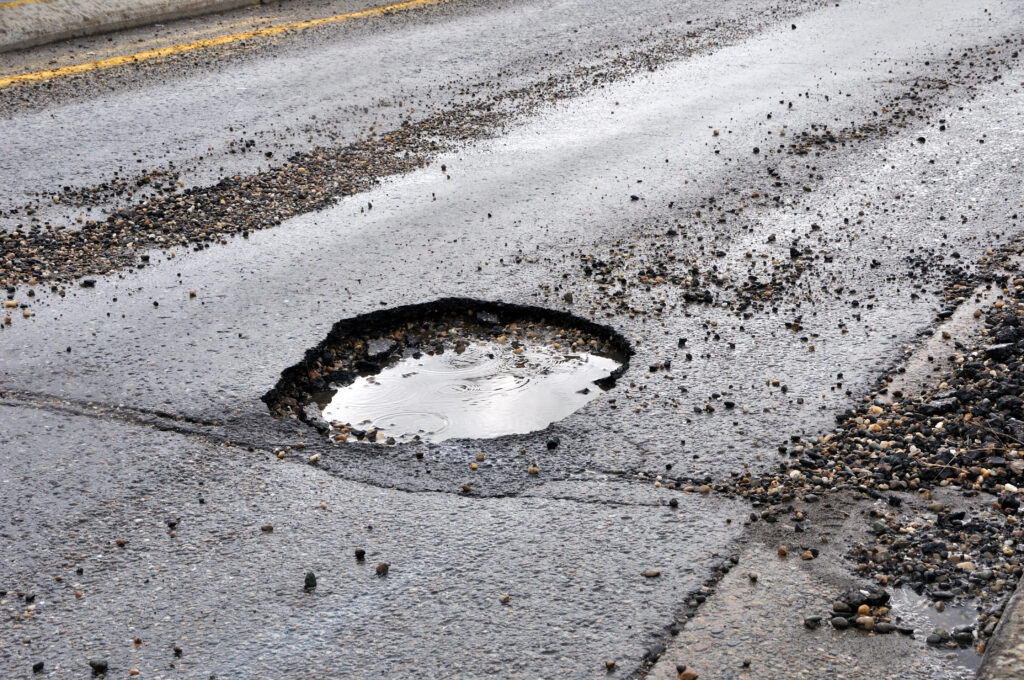
The lowly pothole plagues drivers all around the country. It damages wheels, tyres and suspension. It makes drivers swerve. It makes cyclists fall off. And it makes people fed up.
Potholes usually form when water leaks through a surface crack. When it freezes and expands, it weakens the surface. Then, when cars drive over the top, the surface breaks down. And thus, another pothole is born.
We can’t stop the rain, and there are no practical alternatives to asphalt right now. So, the question then becomes, how do you repair potholes properly? Once? Without repeat call-outs?
Here at MR Surfacing, we repair potholes throughout the Midlands. Our experts know how to do it well. Here’s our process.
How do you assess a pothole before repair?
Before we start repairing a pothole, we conduct an assessment. We need to know its size, depth, location and, most importantly, its root cause. That’s because a shallow pothole in a car park undergoes very different stresses, strains and conditions from a deep pothole in a live traffic lane.
We’ll inspect the edge of the pothole to see if it’s breaking down. We’re also looking for signs of cracking around the pothole and to spot any water ingress. Basically, we need to know whether the pothole is a surface or sub-base issue. The last thing we want is to treat the pothole surface without remedying the fundamental problem.
We won’t just look at the pothole, though. We also need to know the typical traffic type, weight and frequency. For instance, a pothole on a footpath might require nothing more than a simple cold-patch repair. However, one on a busy main road or a loading area most likely needs a more substantial hot-lay or structural solution.
Once we decide what needs to happen, we’ll get your approval before we start. Next comes the temporary signage, barriers, traffic management systems and all the other necessary safety processes. Then, the work begins.
What repair methods are used for potholes?
Pothole repairs generally fall into three categories. We’ll decide which of these approaches to use in the assessment mentioned previously:
- Temporary repairs (cold patch) use cold-lay materials. Crews clean the hole, place the material, compact it and reopen the surface. This is a quick way to get a road or car park space back open, but it isn’t a permanent solution.
- Permanent patch (hot patch) repairs offer better performance. Again, crews cut back the damaged area until only firm, stable material remains, then form clean, square edges and remove all loose debris. They apply a tack coat, lay hot asphalt, and compact it in layers. This restores the surface integrity and should blend in well with the surrounding material.
- Structural repairs (sub-base repair + hot patch) go deeper than the surface. When a pothole forms due to a failed sub-base, our crews excavate beyond the asphalt layers and remove any weak or water-damaged sub-base material. They rebuild the sub-base using compacted aggregate laid in layers, then lay and compact new hot asphalt on top.
There are also spray-injection methods for pothole repair. These use a combination of bitumen emulsion and aggregate, applied under pressure into the hole. The process seals the surface and bonds the materials quickly, allowing the road to reopen almost immediately. Spray injection works best on small to medium defects where the surrounding structure remains sound.
What materials matter most in pothole repair?
Hot asphalt provides the strongest permanent repair when weather and road access permit it. Hot asphalt compacts well, supports heavier traffic loads and bonds to existing surfaces, which helps prevent the pothole from reopening.
As we discussed briefly above, you can cold-lay asphalt. It’s a decent temporary solution, basically trading strength and longevity for speed and flexibility. It won’t last long on most roads, so it’s important to prepare for a hot-lay asphalt patch.
We always cut the pothole edges into straight lines. While this might look satisfying, it’s more about making sure we get a good seal around the edge. Unsealed patch edges let rainwater back in, which will cause the pothole to reopen. We also use proper tack coats and joint sealers to reduce that risk.
We always put a strong emphasis on compacting. Even the best asphalt materials fail if they’re under-compacted. The layer thickness must suit the equipment used, and even small patches need small rollers or vibrating plates to get the right density.
And last of all, there’s the one factor that nobody can ignore, and nobody can do anything about: the weather. Cold and wet conditions mean that a pothole repair won’t bond as well as if it’s warm and dry. However, a road can stay closed for only so long. We always do our best to plan around the weather, but sometimes, repairs must be made regardless.
Can MR Surfacing repair potholes?
Absolutely. Here at MR Surfacing, we’re fully equipped to tackle any pothole repair, big or small, around the Midlands and beyond.
A complete pothole repair from us isn’t just a thoughtless patch to temporarily fill a hole. We make it our mission to restore your confidence in the surface. We want to help you prevent future potholes and other failures. And we work with you as a strategic partner to make that happen.
If you manage roads, car parks, or access routes and want pothole repairs that last, MR Surfacing can help. Speak to our team today to plan your pothole repairs that solve the problem, not just the symptom.
