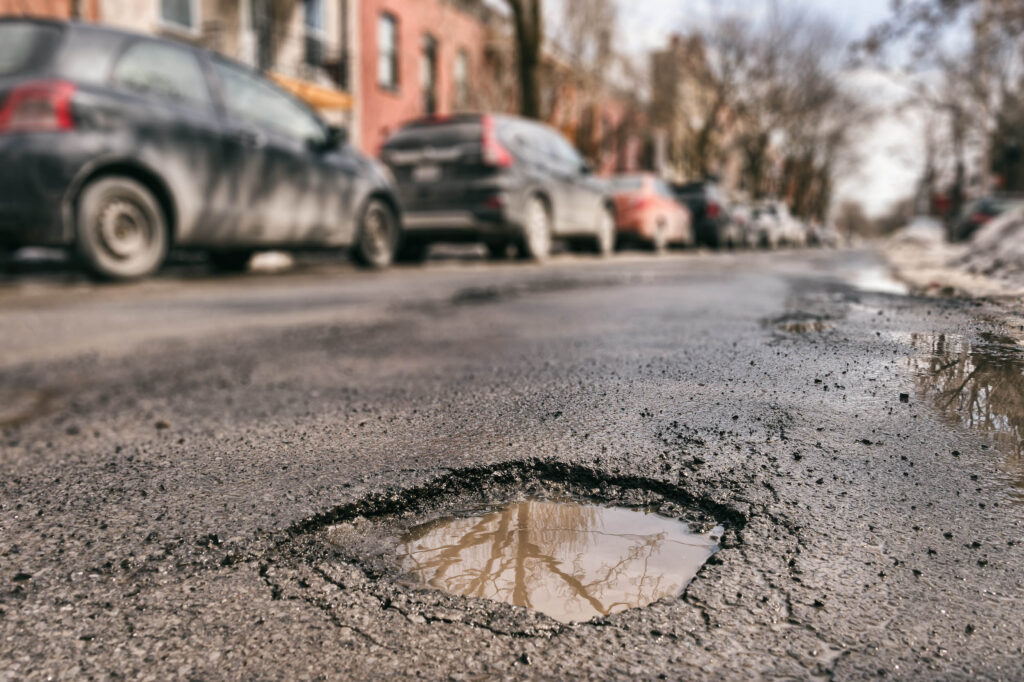
Potholes. A word despised by everyone in our wet island nation, even though they’re part of daily life for most drivers and road users.
A pothole usually begins as a thin crack to which no one pays a second glance. Rainwater pools into that crack. Then, cold weather causes the pooled water to freeze and expand. All the while, traffic passing overhead pushes down on that weak spot. Eventually, the surface gives way and a pothole appears.
So, as a council, an estate team, or a retail site manager, what now? Who repairs these highway potholes? And who might an unhappy driver direct their claim to after a pothole damages their wheel?
On this page, MR Surfacing explains who repairs highway potholes, and where professional surfacing contractors fit in.
Who holds responsibility for pothole repairs on public roads in the UK?
Most potholes on city, village, suburban and countryside public roads fall under the jurisdiction of the local highway authority. Here in England, this usually means the county council, unitary authority or metropolitan borough council. These bodies are legally bound (under the Highways Act 1980) to maintain all roads under their charge.
However, that doesn’t necessarily mean every little pothole can be instantly repaired. Councils inspect roads on set cycles based on traffic type and frequency. For example, a main street receives more frequent checks than a residential cul-de-sac. Once council inspectors find a pothole that needs addressing, it may be scheduled for repair.
Here, councils have to start prioritising. There are inevitably thousands of repair jobs across their city or region. For example, a little pothole far away from a wheel track (where a car’s tyres typically sit in the lane) might be monitored rather than repaired straight away. On the flip side, a deep pothole in the path of a car’s wheels will get higher priority.
And budgets also come into play. Local councils have a budget. As much as everyone would love it, there isn’t unlimited cash to throw at our local roads. And when the money is available, it’s usually most cost-effective to rely on patching as much as possible, prolonging the periods between full resurfacing.
So, when a resident or commuter hits a pothole within a council’s area and it damages their wheel, that council is where their claim goes. Whether the driver receives their claim depends on whether the authority followed its own inspection and repair policy. That’s why it’s so essential to develop a straightforward road maintenance plan, stick to it, and keep transparent records.
What role does National Highways play in fixing potholes?
However, not all roads belong to councils. For example, motorways (like the M1 or the M6) and long sections of major A roads, such as the A14, A38, A42, or A46, fall under the responsibility of National Highways (formerly Highways England).
National Highways operates under a different framework. It’s responsible for the inspections, maintenance and repair work across its entire road network. It’s a Government-owned company through the Department for Transport, with performance targets set by the current Government’s road investment strategies (the RIS process).
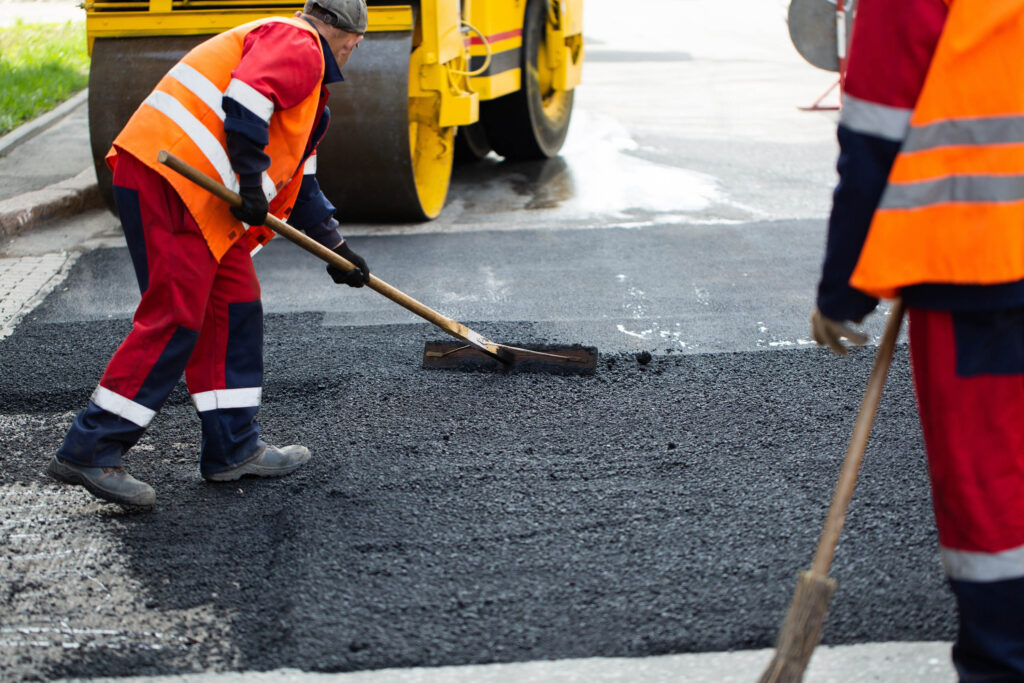
National Highways also uses maintenance contractors for surfacing and repair work. These contractors handle routine pot hole repairs, resurfacing, emergency works, and sometimes specialist services.
So, when it comes to these major highways, pothole repairs have a higher priority. After all, more cars are travelling on these roads, and they’re going much faster, so a pothole is a greater safety risk.
When crews need to repair a pothole on a motorway or A road, it involves lane closures, traffic management, and most often roadworks at night. Repairing a pothole on a motorway is a very dangerous job, and the safety considerations must be taken seriously.
Perhaps the main confusion for councils and site owners comes from where local roads connect to motorways or A roads. For example, with some slip roads, roundabouts, junctions or major crossroads, it might not be clear who has jurisdiction and responsibility.
In these cases, it’s best to liaise with National Highways (or whoever may be responsible for pothole repairs on your particular stretch of road).
What happens when potholes form on private or shared land?
So, that’s local roads and major roads covered. But what about potholes on private land? After all, retail parks, industrial estates, access roads, driveways, warehouse loading areas, and so on all experience frequent, heavy traffic.
Well, as you might expect, the responsibility lies with the landowner or managing agent when it comes to private land. This includes car parks, service yards, internal estate roads and anywhere someone might be driving, whether they’re an employee, a supplier, another stakeholder, or a member of the public (see the Occupiers’ Liability Acts).
There’s an added layer of complexity when it comes to shared access roads. Some of these remain unadopted (that is, the highway authority isn’t obliged to maintain it at public expense). However, homes and businesses might rely on them.
In these cases, pothole repair is most likely to fall to residents, management companies, or leaseholders (residential or commercial). If you find yourself in this situation, it’s best to chat with your neighbours about the best approach.
How MR Surfacing helps you repair highway potholes
Private sites, like those we just discussed, don’t usually follow the same inspection routines as councils. The first that these landowners or managers might hear of a problem is when users report damage to their vehicles or, worse, themselves.
The best way to reduce these risks is to turn to proactive, planned maintenance. This involves regular checks, drainage control and timely resurfacing to extend your surface life, limit disruption, and minimise the risk to all users.
And that’s where MR Surfacing can help. As contractors, we assess your surfaces, confirm the construction type, and recommend the most cost-effective and lowest-risk ongoing plan. If everything looks generally healthy, a patch pothole repair in your car park or driveway might be all you need.
And for councils, contractors are far more useful than simply for emergency work. Plan a programme with us to maintain your highways, so we can help cover the pothole backlog. Our expert team delivers cost-effective, high-quality repairs with minimal interruption to the traffic flow.
Plus, as a local surfacing contractor in the Midlands, MR Surfacing knows the area. We live here, after all. We’re here to support local councils, estate managers and commercial property owners by fixing potholes, laying durable surfaces and helping you stay on top of their regular maintenance.
So, once you know who’s responsible for fixing a pothole, it’s time to act. If you manage roads, car parks, or access routes and need support with assessment or repair, speak with MR Surfacing today.